


Parco
4.3★ average rating (App Store & Google Play) | Up to 30% reduction in parking search traffic | 350+ cities onboarded
Year:
2022 - 2025
Category:
Mobility Management App
Role:
Lead Product Designer

Project Overview
For the Parco app (by SWARCO), the goal was to (re)design a seamless, scalable, and intuitive digital product experience that empowers users to find, navigate, and pay for parking digitally, while helping municipalities reduce traffic congestion, emissions, and optimise urban parking infrastructure.
Problem Statement
Drivers waste time and fuel searching for parking due to fragmented systems across streets, garages, and private lots. This leads to stress, traffic, and emissions. Cities lack integrated tools for managing parking, payments, and mobility data. A unified, digital solution is needed – one that offers real-time availability, cashless payments, and collects actionable insights to optimise traffic flow and infrastructure planning.
Research & Analysis
Main tools used to get to the core of users/municipalities and business needs:
UX Audits – looking on a granular level internally at PARCO app, and externally at the main competitors.
Key Stakeholder Interviews – urban drivers with different degree of experience, city ops, SWARCO business strategy and product leads, devs, and (partner) ParkHere business intelligence team.
Analysis – looking at the main German cities’ current parking solutions.
Benchmark – cross-industry for parallel markets inspiration.
Key Challenges & Insights
Today’s parking ecosystem is fragmented and frustrating: drivers lack real-time availability, many still rely on cash or physical machines, and have no time flexibility or reminders during sessions this leads to last-minute searching, stress, traffic jams, and fines. For cities, that inefficiency compounds into higher congestion and emissions, underused infrastructure (parking lots, EV spots), poor forecasting, and costly in-person enforcement, while disconnected systems prevent end-to-end visibility. At the same time, parking apps face their own challenges: the journey is too complex or too bare, friction drives low adoption and user drop-off (lost revenue), and solutions remain hard to scale across multiple municipalities.
Main pain points:
No real-time info
Poor UX payment process
No reminders/time extension
Lot manager physical presence
More traffic gems
Specific areas with higher CO₂ emissions
Little planning and forecasting capabilities
Solutions
Drivers outcome
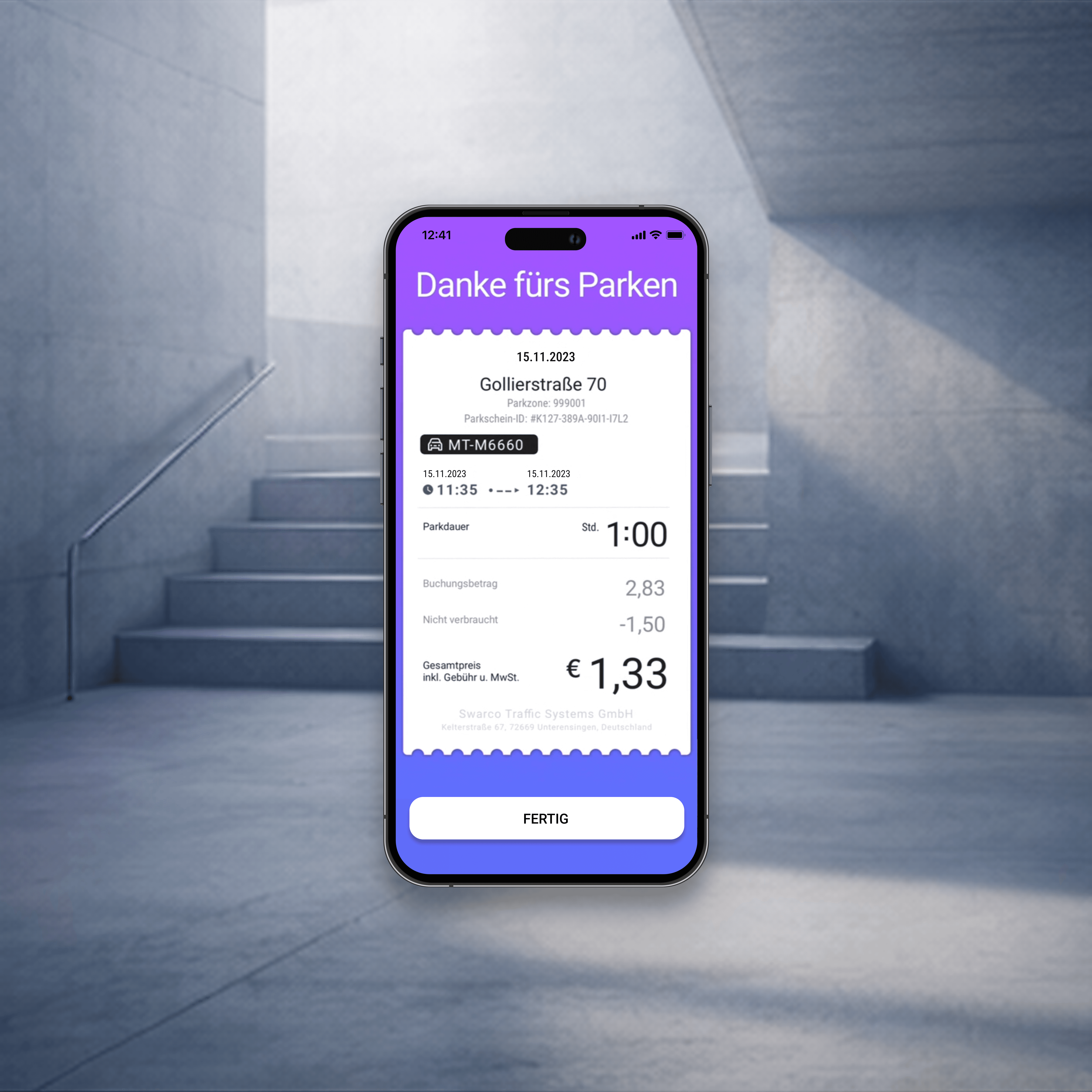
The experience was built around speed and certainty: live updates through sensor-integrated maps, one-tap digital and mobile payments, and a fully cashless, app-based flow. Smart session management let users start, stop, extend, and receive notifications effortlessly, while predictive guidance and routing optimization helped them get to the right spot faster.
Cities outcome
The platform enabled smarter routing and reduced search time, helping lower CO₂ output, while bringing road, garage, EV, and private parking into one integrated system. With centralised usage data and real-time management dashboards, teams could remotely monitor operations and support digital enforcement, all within a scalable setup designed for multi-city mobility integration.
Product outcome
The goal was to simplify the experience with seamless UX across all touchpoints, while enabling a flexible billing and subscription model that fit different needs. A delightful, branded interface helped boost trust and confidence, and a modular system ensured the solution can adapt smoothly to each municipality.


Business Results
Adoption & Usage
350+ cities onboarded (multi-city support across Germany).
∼40% of downloads are monthly active users.
User Experience & Engagement
4.3★ average rating (App Store & Google Play).
>70% of users sign up & complete first parking session within 24 hrs.
35% of users extend parking sessions, showing high adoption of flexible session control.
<2 min average time to initiate a parking session (from search to confirmation).
Operational & Mobility Impact
Up to 30% reduction in traffic related to parking search (in cities with full sensor integration - validated by SWARCO PGS data).
15% decrease in average parking-related CO₂ emissions (thanks to guided routing).
>80% of available parking resources mapped (including public, private, and EV stations).
Financial & Business Indicators
25% of transactions via monthly subscription models (vs. pay-per-use).
3–5% parking revenue increase (per city - after full integration with private parking lots).
City & Infrastructure Insights
Real-time occupancy accuracy >95% via SWARCO sensors.
BI dashboards used by 25% of municipalities (supporting traffic planning and parking optimization).
Recommendations

Projects
other


